The flat minimum feed-in tariff for 2025-26 was lower than that for 2024-25 mainly due to lower daytime wholesale electricity prices.
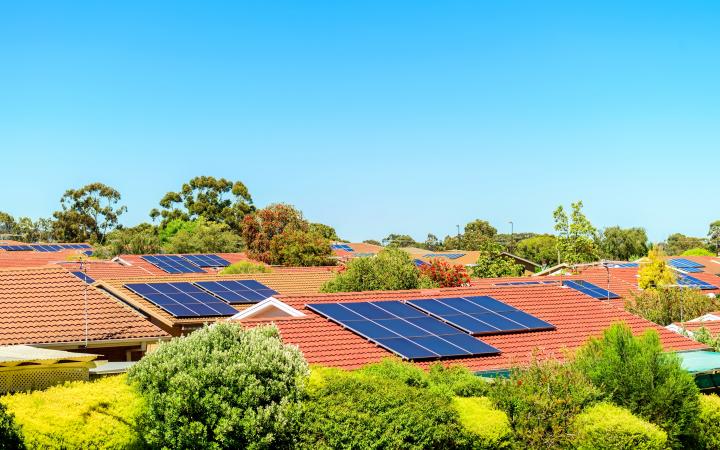
The increased number of households with roof-top solar reduced demand and increased supply. This drove down the wholesale electricity prices especially during daylight hours when most solar exports are occurring.
The time-varying minimum feed-in tariffs ranged from 6.57 cents per kWh in the evening peak to 0.00 during daytime hours. Minimum tariffs differed between the two options due to differences in time-block periods.
Minimum feed-in tariff review 2025–26
The Essential Services Commission no longer sets minimum feed-in tariffs, following an amendment to the Electricity Industry Act 2000. The 2024-25 minimum feed-in tariffs applied until 30 June 2025, but there will be no minimum feed-in tariffs from 1 July 2025.
From 1 July, electricity retailers may set their own feed-in tariffs. However, these cannot be below zero ($0.00) cents per kWh. More information is available from the Department of Energy, Environment and Climate Change.
See this page about our past decision on the 2025-26 minimum feed-in tariffs.
Key facts of our final decision
Wholesale prices were forecasted to decline especially during daylight hours
The main benefit of solar is avoiding the retail price
Customers avoid retail tariffs by self-consuming the electricity they generate.
For a customer on the Victorian Default Offer prices in 2024–25, the retail price ranged from approximately 26 to 35 cents per kilowatt hour, depending on their distribution zone – these were the actual costs that solar customers avoid.
Please refer to our full final decision report for more detailed analysis.
Why do the minimum feed-in tariffs change each year?
The video below explains how the wholesale electricity prices during different times of day and night affect the minimum feed-in tariffs.
The minimum feed-in tariffs change each year mostly because of changes in solar weighted wholesale electricity prices. In recent years, solar weighted wholesale electricity prices during the middle of the day, when most solar is exported, have been going down.
The wholesale price is set in a competitive national market, based on electricity supply and demand. The wholesale price is not set by the government or a regulator.
Tips to make the most of your solar
The video below explains how the wholesale electricity prices during different times of day and night affect the minimum feed-in tariffs.
The value for solar customers is avoiding retail prices by using the electricity they produce themselves.
- Customers’ solar systems only export ‘leftover’ electricity. The electricity their systems produce power their homes and businesses first. Where possible, run your power-hungry appliances - washing machines, dishwasher, hot water heater - during the middle of the day and avoid retail prices.
- Consider the advantages (and disadvantages) of 'time of use' feed-in tariffs when working out which electricity retailer meets your needs. Also beware that a higher feed-in tariff may mean you pay higher import tariffs.
Next step
The 2024-25 minimum feed-in tariffs applied until 30 June 2025. From 1 July, electricity retailers may set their own feed-in tariffs.
These cannot be below zero ($0.00) cents per kWh. More information is available from the Department of Energy, Environment and Climate Change.
Lumea Pty Ltd as trustee for the Lumea Trust - electricity transmission licence
On 5 December 2024 Lumea Pty Ltd as trustee for the Lumea Trust (Lumea Pty Ltd) (ACN 626 136 865) applied to the Essential Services Commission for an electricity transmission licence in Victoria.
Public consultation on this application closed on 20 January 2025. You can read the submission we received in the Resources tab above.
We granted the licence on 5 March 2025.
Terrang BESS Asset Co Pty Ltd as trustee for Terrang BESS Asset Trust
On 15 November 2024, Terrang BESS Asset Co Pty Ltd as trustee for Terrang BESS Asset Trust (ACN 651 342 120) applied for a licence to generate electricity under section 18 of the Electricity Industry Act 2000 (Vic).
Consultation on the licence application closed on 16 December 2024. We did not receive any submissions.
We granted the licence on 15 January 2025.
Victorian Default Offer price review 2025–26
Overview
We are responsible for setting and annually reviewing the Victorian Default Offer prices. The default offer is designed to be a simple, trusted and reasonably priced electricity option that safeguards customers who are unwilling or unable to engage in the electricity market.
We have set the Victorian Default Offer prices to apply from 1 July 2025 to 30 June 2026.
How cost components and annual bills will change under our final decision
Change in the average Victorian Default Offer annual bill by cost component, for domestic customers with annual usage of 4,000 kWh, $ nominal
Change in the average Victorian Default Offer annual bill by cost component, for small business customers with annual usage of 10,000 kWh, $ nominal
Key facts from our final decision
We have made some changes to the method used to calculate default offer prices
We have lowered the retail operating margin and changed the data used to calculate wholesale electricity costs. For the other costs our final decision uses generally the same approach as our last decision.
Default Offer prices in 2025-26 are slightly higher compared to 2024-25
The main factors influencing the proposed price changes are higher wholesale electricity and network costs, which are partially offset by lower environmental costs.
Support is available to help you manage and pay your energy bills
Victoria has one of the most comprehensive sets of energy consumer protections and assistance programs in Australia. A range of support and information on your right to assistance is available.
Victorian Default Offer 2025–26: Final Decision
Victorian default offer prices to apply from 1 July 2025 to 30 June 2026
Fixed flat tariffs for general usage and general usage+controlled load usage – domestic customers (including GST)
| Distribution zone | Supply charge ($ per day) | Usage charge structure | Usage charge (not controlled load) ($ per kWh) | Usage charge: controlled load1 ($ per kWh) |
|---|---|---|---|---|
| AusNet Services | $1.4146 | Block 1 (up to 1020 kWh during a quarter) Block 2 (> 1020 kWh during a quarter) | $0.3477 $0.3477 | $0.2399 |
| CitiPower | $1.2407 | Anytime | $0.2733 | $0.2012 |
| Jemena | $1.2301 | Anytime | $0.2972 | $0.2314 |
| Powercor | $1.3684 | Anytime | $0.3009 | $0.2122 |
| United Energy | $1.1648 | Anytime | $0.2884 | $0.2107 |
1 Only if a controlled load or dedicated circuit is available with the customer.
Fixed flat tariffs for general usage – small business customers with consumption less than 40 MWh per year (including GST)
| Distribution zone | Supply charge ($ per day) | Usage charge structure | Usage charge ($ per kWh) |
|---|---|---|---|
| AusNet Services | $1.4146 | Block 1 (up to 1020 kWh during a quarter) Block 2 (> 1020 kWh during a quarter) | $0.3881 $0.3881 |
| CitiPower | $1.4469 | Anytime | $0.2657 |
| Jemena | $1.5834 | Anytime | $0.3141 |
| Powercor | $1.5905 | Anytime | $0.2927 |
| United Energy | $1.3711 | Anytime | $0.2789 |
Two period time of use tariffs – domestic customers (including GST)
| Distribution zone | Supply charge ($ per day) | Peak usage charge ($ per kWh) 3 pm to 9 pm everyday | Off peak usage charge ($ per kWh) All other times | Usage charge: Controlled load ($ per kWh)1 |
|---|---|---|---|---|
| AusNet Services | $1.4146 | $0.4682 | $0.2399 | $0.2399 |
| CitiPower | $1.2407 | $0.3633 | $0.2206 | $0.2012 |
| Jemena | $1.2301 | $0.3761 | $0.2368 | $0.2314 |
| Powercor | $1.3684 | $0.4040 | $0.2365 | $0.2122 |
| United Energy | $1.1648 | $0.3837 | $0.2299 | $0.2107 |
1 Only if a controlled load or dedicated circuit is available with the customer.
Two period time of use tariffs – small business customers with consumption less than 40 MWh per year (including GST)
| Distribution zone | Supply charge ($ per day) | Peak usage charge ($ per kWh) 9 am to 9 pm weekdays | Off peak usage charge ($ per kWh) All other times |
|---|---|---|---|
| AusNet Services | $1.4146 | $0.4031 | $0.2198 |
| CitiPower | $1.4469 | $0.3305 | $0.1947 |
| Jemena | $1.6722 | $0.3579 | $0.2028 |
| Powercor | $1.5905 | $0.3895 | $0.2111 |
| United Energy | $1.3711 | $0.3501 | $0.2027 |
Our price determination covers all types of standing offers including those based on time-of-use, demand and flexible tariff structures.
How we calculate the Victorian Default Offer
We are required to base the Victorian Default Offer on the efficient costs of the sale of electricity by a retailer. In doing so, we take into account:
- Network costs - based on distributors' network tariffs and metering charges approved by the Australian Energy Regulator.
- Wholesale electricity costs - based on the forecast cost of purchasing electricity in the futures market, including a wholesale cost of exports and factoring in a volatility allowance.
- Environmental costs - based on retailers' costs of complying with environmental obligations imposed under Commonwealth and Victorian law or regulation.
- Retail operating costs - based on the customer-weighted average of the retailers' actual retail operating costs for domestic and small business customers. These costs include modest customer acquisition and retention costs - based on the 2013-14 average acquisition cost benchmark updated for inflation.
- Other costs - Australian Energy Market Operator fees, ancillary service fees, licence fees and market intervention costs.
- Network loss factor - based on information from the Australian Energy Market Operator, and applied to wholesale electricity costs, environmental costs and variable other costs.
- Retail operating margin - based on a retail operating margin benchmark and having regard to market offer prices relative to default offer prices, the expected returns approach and retailers' actual margins.
Contact us
If you have any questions about the review you can contact us using the following methods:
- Email: VDO@esc.vic.gov.au
- Mail: Essential Services Commission, Level 8, 570 Bourke Street, Melbourne Victoria 3000
- Phone: 03 9032 1300
Next steps
Victorian Default Offer 2025–26 prices will come into effect from 1 July 2025
Latrobe Valley BESS Pty Ltd as trustee for Latrobe Valley BESS Project Trust - electricity generation licence
On 17 October 2024, Latrobe Valley BESS Pty Ltd (ACN 648 205 127) as trustee for Latrobe Valley BESS Project Trust applied for a licence to generate electricity under section 18 of the Electricity Industry Act 2000 (Vic).
Consultation on the licence application closed on 14 November 2024. We did not receive any submissions.
We granted the licence on 12 December 2024.
EE Solar 6 Pty Ltd - electricity generation and sale licence
On 14 October 2024, EE Solar 6 Pty Ltd (ACN 664 407 121) as trustee for EE Solar 6 Trust applied for a licence to generate electricity under section 18 of the Electricity Industry Act 2000 (Vic).
Consultation on the licence application closed on 11 November 2024. We did not receive any submissions.
We granted the licence on 14 November 2024.