
Our stakeholder engagement framework - incorporating the charter of consultation and regulatory practice - describes what you can expect of us as we engage to make decisions in our role as Victoria's regulator of essential services.
Stakeholder engagement framework

Our stakeholder engagement framework
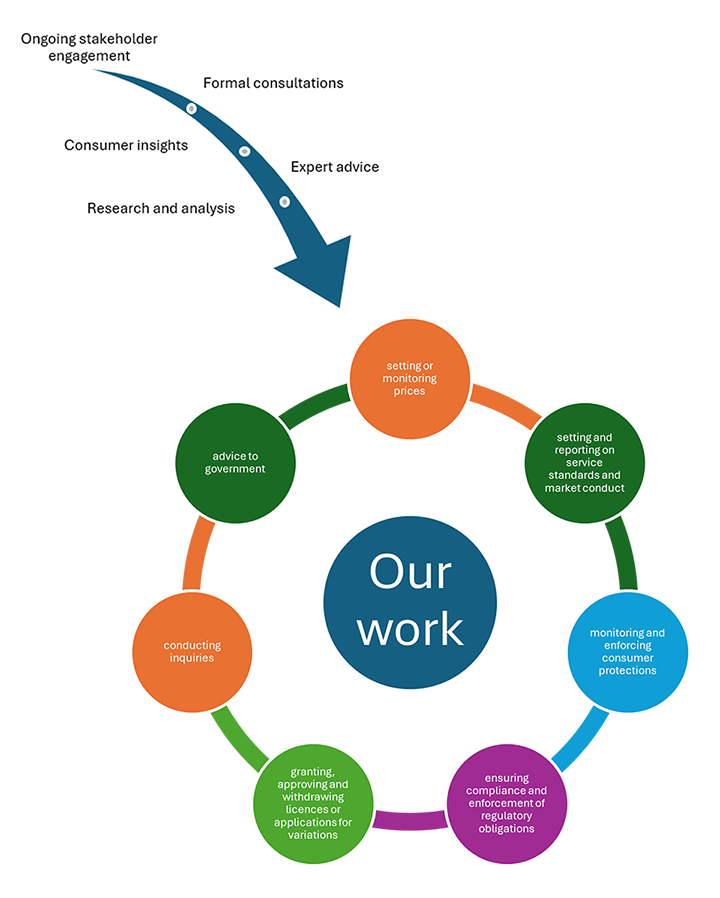
As the state’s economic regulator of essential services, the commission’s work touches the lives of every Victorian every day.
Whether we are setting prices, enforcing consumer protections, reporting on service standards or market performance, or determining rate cap applications, our decisions have the potential to affect many aspects of life for every household and business across the state.
We believe engaging with stakeholders is important to this work. For example:
- Consulting directly with businesses and consumer advocates means we understand more about the issues and trends affecting the sectors we work with and the concerns of Victorian consumers.
- By involving other regulators, we can check for coherence with other regulatory regimes to minimise conflict and overlap.
- Publishing draft decisions and calling for submissions tests the feasibility of our ideas.
- Engaging openly, frequently and consistently helps ensure we’re well informed and transparent.
Our commitment to effective stakeholder engagement is described in our charter of consultation and regulatory practice (contained within this framework). Required by our primary legislation* , the charter includes guidelines relating to processes for making decisions and conducting inquiries. It describes our commitment to achieving excellent regulatory practice also required by relevant government guidelines.
We continue to build our understanding of the sectors and businesses we regulate, and we understand that what we do can have an impact on the cost of doing business. This charter embodies our commitment to learning from experiences and responding to feedback and changes in the environment.
The charter is the core guiding document of our stakeholder engagement framework which aims to promote consistency of practice and excellence across the organisation. Our engagement is evaluated on an ongoing basis, and the charter will be reviewed every three years.
Engaging with stakeholders is essential to our work
We value the knowledge and perspectives of stakeholders. From across the sectors we regulate, to consumer and community representatives, experts and the wider community who are affected by the decisions we make, we value your input.
Our engagement framework is designed to provide stakeholders and the community with a range of ways to contribute to our work.
*Essential Services Commission Act 2001 s. 14(1)
Good engagement is part of our culture
Our engagement framework is designed to support a culture of best practice. The framework is underpinned by:
- the charter of consultation and regulatory practice – describes our commitment to engagement including the principles we aspire to and guidelines informing our processes for making decisions and conducting inquiries
- a community of practice – an internal engagement champions group actively involved in further developing and enhancing the quality of our engagement
- ongoing evaluation and assessment of engagement activities to facilitate continuous improvement.
Our engagement is multi-faceted and meaningful
We aim to provide ways for stakeholders to contribute meaningfully to our work. We use a range of methods to keep stakeholders informed and develop engagement processes that are tailored and fit for the task at hand.
| With your input, we consider and plan our engagement to make it genuine and meaningful | One on one discussions Surveys Workshops, forums or webinars Engagement feedback forms Early notification |
| We are transparent, accountable and keep you informed about decision-making | Project web pages Fact sheets Emails, newsletters, media releases Reports and associated submissions Annual work program Annual report Social media |
| We learn from our engagement efforts to improve future activities | Submissions Surveys Project and program evaluation reports Regular objective assessment of engagement efforts |
| We seek diverse perspectives from those affected by, or interested in, our work | Workshops, forums etc. Public hearings Working groups, reference panels Focus groups Reports and submissions |
Our charter of consultation and regulatory practice
The charter is your guide to what you can expect from us as we engage to make decisions in our role as Victoria’s regulator of essential services.
Required by legislation*, the charter is also an expression of our commitment to high standards of stakeholder engagement and regulatory practice. It’s just one way we seek to demonstrate we are independent, balanced and fair. The charter includes principles for engagement and guidelines to describe our processes for making determinations and other regulatory decisions and conducting inquiries.
*Section 14-15 of the Essential Services Commission Act 2001
We aspire to being a leading regulator
We are an organisation that promotes innovation and aspires to deliver great performance. We are innovative, original and willing to challenge conventional ways of working in the pursuit of more efficient and effective outcomes. We invest in people and systems to support thought leadership and great performance.
Our primary legislative objective is to promote the long-term interests of Victorian consumers. The engagement framework and charter of consultation and regulatory practice aim to support this objective as well as reflecting our ambition to be a leading regulator.
We are committed to building our understanding of the sectors in which we work, learning from our experiences and improving in response to feedback and changes in the environment.
Our approach aligns with relevant government guidelines including the Victorian Government’s Public Engagement Framework 2021-2025 and Statement of Expectations Framework for Regulators, including a commitment to:
Timeliness:
- developing systems and processes to make it as easy as possible for businesses to complete forms, submit data and check on the status of applications
- providing clarity about the timing and scope of regulatory processes improving e-capability.
Cooperation among regulators:
- coming together with other regulators, particularly where our regulated parties overlap, to identify good practice and share lessons learned
- exploring ways to facilitate data sharing and benchmarking ourselves against other regulators.
Stakeholder consultation and engagement:
- sharing information and, where appropriate, providing opportunities to contribute to regulatory design
- considering views and advising on the outcome of consultation.
Accountability and transparency:
- being transparent and, where appropriate, how we administer and enforce regulation
- collecting and publishing outcome-focused data to measure our operational performance.
We will report on our performance in our annual reporting.
Stakeholder engagement is a building block for better decisions
Stakeholder engagement helps us build respectful and productive relationships, helping create trust and goodwill. It helps us identify emerging issues and trends affecting the sectors we work with and is important to inform unbiased regulatory decision-making.
Our principles underpin our commitment to excellent stakeholder engagement.
Principle 1: We are transparent and accountable
We are clear about what, when and how we consult. We publish information about how we make decisions and explain the decisions we have made.
Principle 2: Our engagement is considered, planned and genuine
We develop plans with the aim of providing time for meaningful, fit for purpose engagement with people who are affected or have an interest in our decisions.
Principle 3: Our engagement is inclusive
Our decisions are well-informed by input from a range of groups and individuals who are affected by or interested in our work.
Principle 4: Our information is clear, accessible and simple to understand
We present information in plain language that sets out clearly what we are doing, how people are affected and how they can get involved.
Principle 5: We listen and learn to improve our consultation and engagement
We evaluate and monitor our engagement and consultation, measuring ourselves against these principles.
What you can expect from the commission
Our five engagement principles, along with the guidelines below describing our processes for making determinations, other regulatory decisions and conducting inquiries, tell you what you can expect from us when we set out to engage on a project or program of work.
Principle 1: We are transparent and accountable
We are clear about what, when and how we consult. We publish information about how we make decisions and explain the decisions we have made.
We publish information about our decisions and processes
Our decision-making processes are reported on our website and through other channels including direct communication with regulated businesses and key groups. We do this so people can engage with our processes and understand how we make our decisions.
We publish key documents including issues and consultation papers, draft and final decisions and consultants’ reports (where appropriate) on our website and provide printed copies on request.
We explain key issues and report stakeholder input accurately
We explain the key issues as we see them and ask stakeholders for feedback via issues papers and consultation papers. We publish submissions and summaries of stakeholder input and explain how this input informed our decisions.
We keep stakeholders informed about our work
We publish a summary of our work program on our website annually, outlining key projects for each of the sectors we operate in. This includes major price and regulatory reviews, inquiries and special projects known to us at the time of drafting with indicative time frames.
Principle 2: Our engagement is considered, planned and genuine
We develop plans with the aim of providing time for meaningful, fit for purpose engagement with people who are affected, or have an interest in our decisions.
Engagement strategies are tailored to fit the task at hand
We are clear about the purpose of our engagement at relevant stages of our projects. Our consultation is tailored to the complexity and potential impact of the issue being considered and the time available.
We publish consultation timelines and opportunities to comment on our website, on the Victorian government’s engagement platform, Engage Victoria, through social media and through targeted sector specific communication like emails, newsletters and forums.
We know our stakeholders are busy, so we try to take this into account. We also engage with other regulators and departments to align, where possible, our work to avoid duplication and overlap.
We notify as widely as possible about our projects
We use a variety of channels to promote opportunities to contribute to projects and inquiries. This could be either in person or in writing, including by email and newsletters, forums and presentations, advertising (e.g. Government Gazette, appropriate newspapers, online) and through peak groups.
We provide expected time frames and requirements for submissions as well as details of any public hearings. We provide regulated entities a copy of these notices.
Principle 3: Our engagement is inclusive
Our decisions are well-informed by seeking input where possible from a range of groups and individuals who are affected by or interested in our work.
We use a variety of engagement methods
We collect a range of views by using the most appropriate engagement methods to enable diverse communities to have input into our work. We may hold seminars and workshops or establish working groups and online forums. We call for submissions on draft decisions.
For a major inquiry, we may establish reference or technical working groups or conduct consumer research.
We engage regularly
We establish formal and informal channels of communication with the sectors with which we work and other key groups who represent a variety of perspectives.
We may hold public hearings to facilitate discussion to support well informed decision-making. We hold public hearings where required (e.g. for an inquiry) or where we see opportunities to promote open discussion of the issues or possible ways forward.
Hearings and forums may be recorded or, where resources allow, broadcast on the internet for those who can’t be there to participate. Parts of a public hearing may be held in private where the commission determines it is in the public interest or there is information of a confidential or commercially sensitive nature.
Principle 4: Our information is clear, accessible and simple to understand
We present information in plain language that sets out clearly what we are doing and how people can get involved.
Plain English is our standard
Our reports are written in accessible language to help stakeholders understand the issues and make informed contributions.
We use multiple channels to reach many audiences
We use a variety of channels to keep key groups informed, regularly updating our website, holding information sharing forums and sending out newsletters. We regularly publish media releases and articles to keep stakeholders up to date and informed about our work.
Principle 5: We listen and learn to improve our consultation and engagement
We evaluate and monitor our engagement and consultation processes, measuring ourselves against these principles.
We collect feedback from participants in engagement activities and look for ways to address the issues raised. We survey stakeholders on their experiences with us and report publicly on our performance on an organisation-wide basis on our website and in our annual report.
We will review this charter to promote effective engagement
We will review this charter, with input from stakeholders, every three years or earlier where changes to our legislative responsibilities or circumstances require.
We invest in people and systems to promote best practice
We invest in people and systems to support great engagement and consultation. The charter is supported by:
- staff guidelines and a toolkit to promote consistency and set expectations and standards
- a capability development program and community of practice to share lessons learned and provide ongoing training and professional development
- standard tools to evaluate and report on consultation
- establishing accountability and reporting on performance at a project, sector and organisation level.
Engagement in practice – timeframes and submissions
These examples show how the process and timeframes will vary according to the size and complexity of the job at hand as well as any limits imposed by external or legislative deadlines.
The elements and time frames are indicative only.
Example 1: a major price review or inquiry
| Stage of process | What will happen | Indicative time frame |
|---|---|---|
| Notification of intent |
| As early as possible following adoption of work plan or receipt of terms of reference from government/minister |
| Engage on process and invite early input |
| Where the terms of reference allow - six to 12 months ahead of any decisions |
| Release issues paper for comment |
| Four to six weeks
|
| Release draft decision for comment |
| Four to six weeks
|
| Release final decision |
| Within two weeks of final decision |
| Advertise final decision |
| Within two weeks of final decision |
| Evaluate and report on process |
| Commence within six weeks of final decision |
Example 2: an annual update of guidance or minor amendments to guidelines
| Stage of process | What will happen | Indicative time frame |
|---|---|---|
| Notification of intent |
| Where possible, up to three months ahead any changes |
| Engage on key issues - test initial thoughts |
| Part of usual engagement program |
| Distribute draft for input |
| Up to four weeks |
| Release updated guidance |
| Up to eight weeks (depending on other priorities and competing timelines) |
| Evaluate process |
| Commence within six weeks of final decision |
Our submissions policy
We accept that all submissions to our reviews or inquiries are made in good faith and consider them in line with our decision-making powers.
We usually publish written submissions on our website unless the provider has requested otherwise and provided us with reasons. In this instance, this information may not be regarded as having the same weight as other input.
We may decide not to publish part or all of a submission if:
- we are concerned it may breach someone’s privacy
- we believe it is inflammatory, offensive or contains inappropriate content
- is outside the scope of the project at hand.
See our submissions policy for more information.
How you can get involved
Our website is the main source of information about our projects and any upcoming or current consultations.
You can call or write to us and ask for printed copies of our reports and publications.
You can register your interest in future consultations by creating a user account on Engage Victoria and selecting 'I would like to stay informed of any future consultations in my area of interests' in your profile settings.
Subscribe to our newsletters or follow us on social media where we promote upcoming opportunities to have your say and get involved:
- LinkedIn: https://www.linkedin.com/company/essentialvic
- Facebook: https://www.facebook.com/EssentialVic
Contact us
Call: +61 3 9032 1300 or 1300 664 969 during business hours 9am- 5pm, Monday-Friday
Email: reception@esc.vic.gov.au and tell us what, if anything, you are particularly interested in
Or write:
Essential Services Commission
Level 37, 2 Lonsdale Street
Melbourne Victoria 3000